Practical manual for maintenance of core materials, consumables and selection of mould accessories of punch card
blog 2026-07-27 20:40:24 109
What is the basic maintenance method of consumables for card punching machines?
The high precision cutting quality of the punching machine is mainly dependent on the gap ratio between punch and cutting punch & die set, the sharpness of the cutting edge and the degree of wear of the positioning mechanism.
1. Selection of mould clearance: When punching PVC/PET plastic cards the unilateral clearance is usually controlled between 5% and 8% of the plate thickness ($t$); paper game cards are controlled between 3% and 5%. \% $; Special filter paper of flexible/fiber type needs small or even zero-gap cutting edges.
2. Daily maintenance principles: follow the principle of “cleaning and lubricating slag every shift, checking the cutting edge every ten thousand times, and regular micro-grinding”. Choose hard alloy (tungsten steel) or powder metallurgy high-speed steel moulds, which can increase the service life of punching machine consumables by more than $300.00.
3. Equipment coordination: high-quality moulds must be built on a stable and high-rigid industrial high-precision punching machine foundation to prevent the mould explosion or abnormal wear of the punch due to eccentricity of the mould seat.
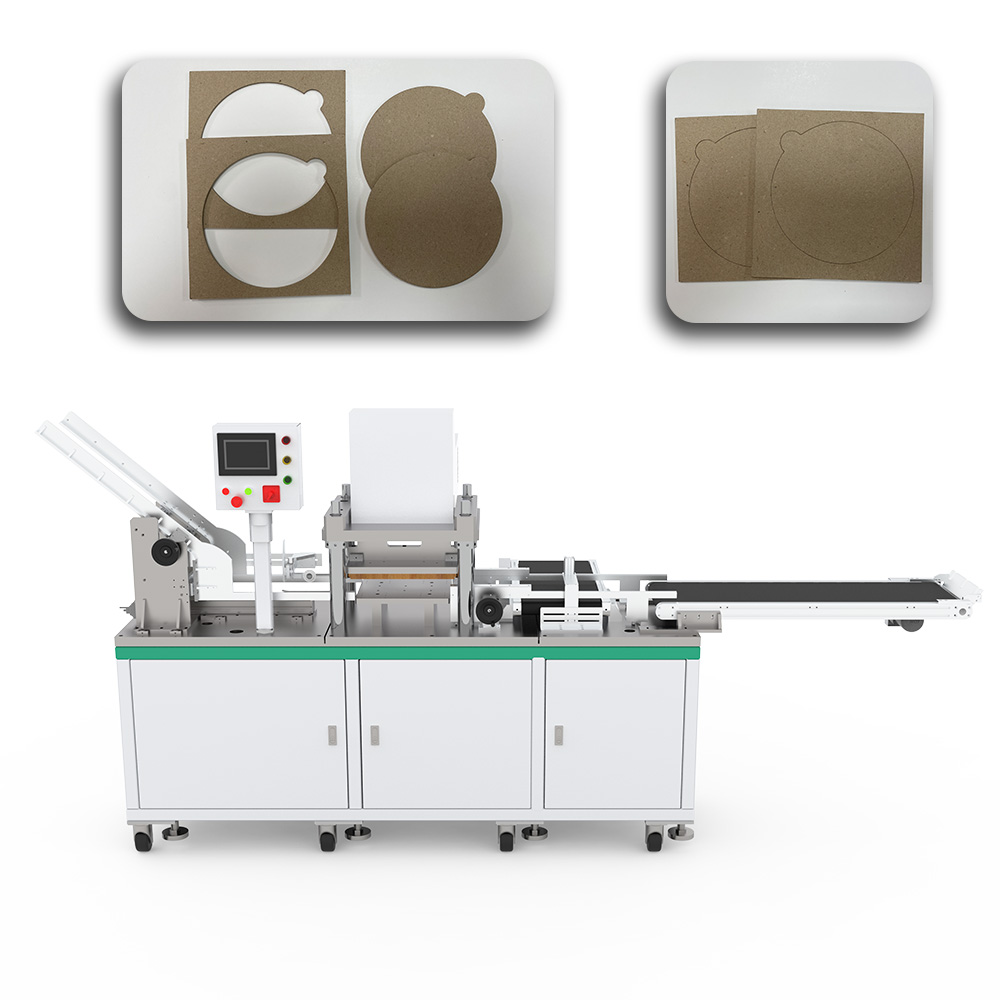
1. Card punching machine key consumables analysis: Which parts need regular maintenance and replacement?
In the automatic card making line, the punching machine is mainly used for the key process of punching and cutting the whole or strip core materials into final shapes with high precision (such as ISO standard smart cards, gaming cards, special industrial filter paper sheets, etc.). A good understanding and proper maintenance of the following key consumables is important for achieving a smooth cut surface without burrs and a dimensional tolerance within $\pm 0.02 \ \textmm}$.
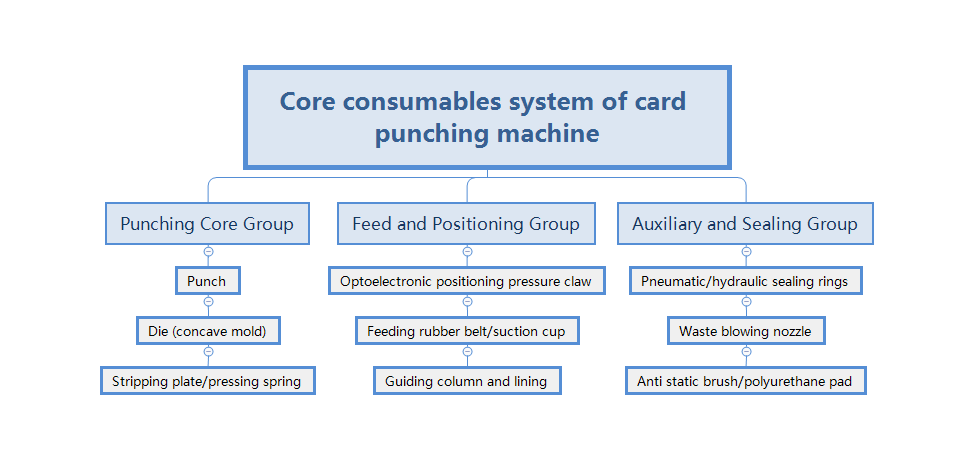
1.1 Punch and Die Set
- The punch and die are the most important components of the punching machine, and they are the ones that wear out the fastest, as they directly bear the high-frequency impact force.
- Upper punch: End face and side scratches susceptible to slight chipping.
- Concave mould: Stress concentration leads to easy collapse, causing burrs and edges below the punch edge.
1.2 Card placement features and hoover cups/feeding belts
The wear of positioning components of high speed automated card punching process may lead to the inaccurate positioning of the card.
- Vacuum suction cup and silicone belt PVC dust or filter paper debris will cause friction decrease or ageing and cracking with long-term contact, resulting in material slippage.
- Photoelectric sensing alignment block: The surface of the mechanical block should be inspected regularly for dents and wear, so as not to affect the accuracy of visual or photoelectric positioning.
1.3 Cleaning of waste, Pneumatic/Hydraulic seals
The ease of waste expulsion directly affects the length of life of the mould. The polyurethane guide pads, the cylinder seals and the blowing nozzles in the waste channel are consumables that need to be replaced periodically. If the waste material gets stuck in the concave mould cavity, the chances of “secondary punching” and punch damage are very high.
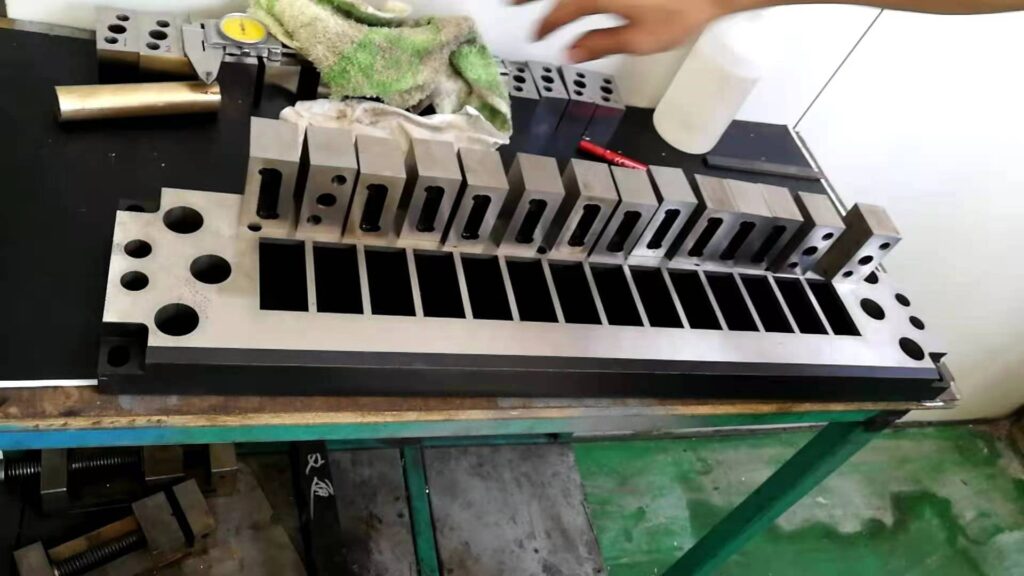
2. Inspection of die wear and edge defects (diagnostic comparison table enclosed)
The best way to diagnose the maintenance status of the punching machine mould is to master the shape of the punching section. The punching section should be a rollover, burnish zone, fracture zone and burr as standard.
The following table shows the most common punching defects and troubleshooting solutions on the production site.
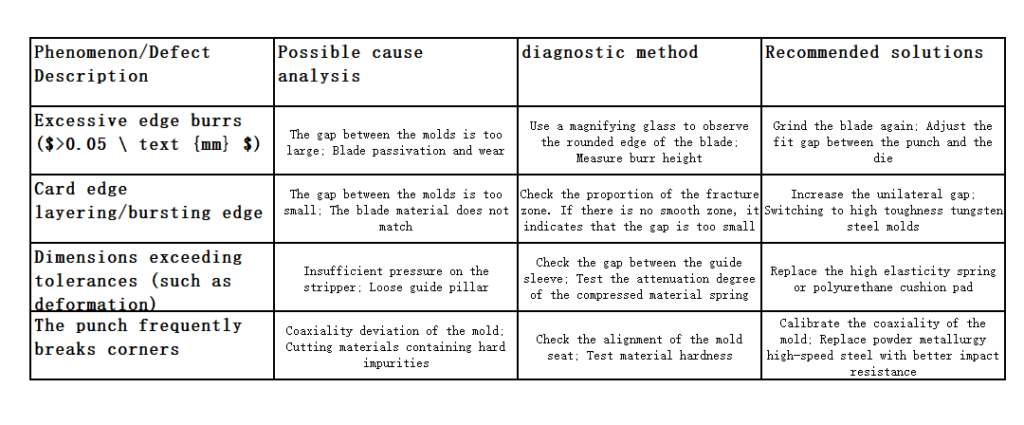
Technical tip: If during troubleshooting you find that the gap between the mould and the material is up to standard, but you still have frequent cases of punching offset or one-sided grinding of the cutting edge, this is usually caused by insufficient overall rigidity of the equipment or gaps in the spindle drive. At this point it is advised to consult the calibration guide for the equipment level system calibration for card punching machines for the alignment accuracy calibration.

3. Mould accessories and tool material selection matrix (Tool material adaptation guide)
Different objects (e.g. paper game cards, PVC/PET smart cards or special industrial filter paper) need to be processed with different tool materials and accessory configurations. This punching machine mould selection matrix can help you to make quick decisions.
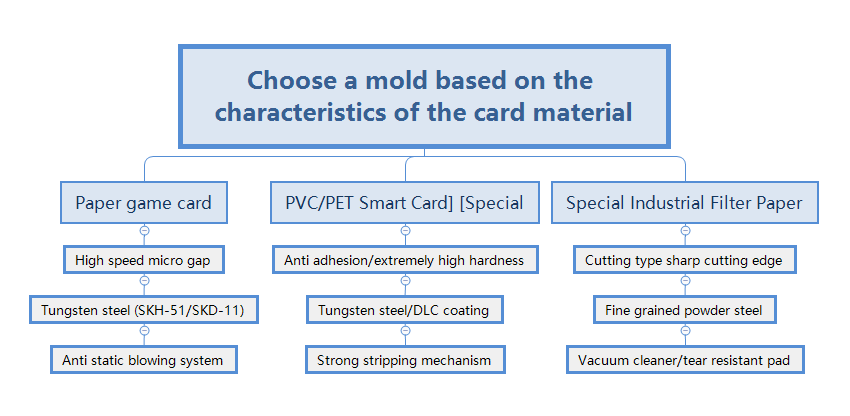
3.1 Game Cards/Paper Cards (High-Speed Paper Cards) 3.1.1.
Material properties: High speed punching 300-500 times/min. High fibre dust, easy to fuzzy material.
Mould accessory selection: SKH-51 high speed steel with high wear resistance or durable alloy (tungsten steel). Mould accessories should be fitted with high-pressure blowing antistatic nozzles to avoid paper scraps sticking to the surface of the mould.
Gap recommendation: Single sided gap $3-5%$ of the material thickness.
3.2 Core material: PVC / Smart card / PET / ABS plastic
Material properties: The material is plastic and tough and is prone to adhesion, electrostatic adsorption and edge bursting. For specific cutting characteristics of plastic card materials, refer to the inspection of punching edge defects in PVC and PET card materials.
Selection of mould accessories: It is recommended to use punch heads with DLC (diamond-like carbon) coating or TiALN coating on the surface, which can effectively reduce the phenomenon of sticking caused by the softening of PVC. The stripping plate should be a double buffering of spring and polyurethane.
Gap recommendation: The single-sided gap is from 5% to 8% of the material thickness.
3.3 Special industrial filter paper and filter paper composite
Material properties: Loose fibres, variable thickness, soft, easy to draw and tear.
Mould accessories selection: Requires the use of ultra-high precision micro-gap cutting tools (micrometer-level matching), the cutting edge needs to be specially ground to maintain the ultimate sharpness of the blade.
Attachment coordination: The concave mould feeding port should be equipped with a strong vacuum suction mould base, so that the filter paper particles will not block the feeding port.
Should you need to customise special cutting tools for special materials such as ultra thick PET or metal composite cards, you can refer to the technical specifications of our customised punching machine moulds and high-end accessory set.
4. Consumables in card punching machine standard daily maintenance SOP
The key to the reduction of consumables consumption and the continuous production of the card punching machine is to establish a standardised maintenance process.
Step 1 – Pre-shift lubrication and slag cleaning (daily)
Clean the waste residue from the concave mould cavity and stripping plate with an anti-static air gun.
Apply SAE 30 precision engine oil or special synthetic grease on the sliding parts of guide column, guide sleeve and punch.
Warning: When cutting paper cards, do not apply lubricating oil to the cutting edge to avoid contaminating the edges of the paper.
Step 2: Regular blade grinding and clearance compensation (weekly/ monthly)
If the cutting burr is of height $>0.03 \ \textmm$, the punch and die should be ground lightly in time.
Flat grinding: Use a flat grinder to micro grind the end face of the cutting edge, the recommended single grinding amount is $0.01-0.02 \ \textmm$.
Deburring and demagnetising. After grinding, the corners need to be manually inverted with an oilstone, and demagnetising treatment must be done (to prevent metal shavings from sticking to the blade edge).
Gasket compensation: Add a precision high-hardness levelling gasket on the bottom of the concave mould with the same thickness as the ground-off material to ensure the dead-center position of the punching is unchanged.
Step 3: Preventing Rust in Storage and Storage Specification (Storage)
The replaced mould accessories should be cleaned with isopropyl alcohol, sprayed with acid-free anti-rust oil and stored in a special mould cabinet with constant temperature and humidity (humidity <50%).
5. Common operational fallacies and warnings for engineers
Disclaimer: Equipment protection and engineering safety:
Strictly prohibit dry friction operation: The high frequency operation of equipment without lubrication or material punching can cause the mould to “bite” due to frictional heat generation in a few seconds.
Not for use outside scope: Do not punch hard PET or metal composite cards with micro-gap moulds specifically designed for paper game cards, as it can cause the punch to instantly crack and fly out causing serious personal safety hazards and equipment damage.
Professional maintenance suggestions: mould grinding and coaxiality calibration need professional grinder operators and high-precision testing instruments (such as anime measuring instrument). Complex punch modules should not be disassembled by non-professionals.
6. See also Further Reading/Guides
We propose the following technical standards to help you build a knowledge system for the operation and maintenance of automated punching and cutting production lines in a systematic way:
Calibration Guide For The Accuracy Of Punching Machine Alignment: A Comprehensive Study Of Error Calibration Between CCD Visual Positioning And Mechanical Alignment.
Research of edge defects of PVC and PET card materials during punching – Detailed comparison of cutting performance of polymer plastic cards at different temperatures and punching speeds.
Industrial high-precision punching machine——Understanding the high rigidity and high automation punching host system configuration.
7. Frequently Asked Question (FAQ)
Q1: How long does the punching machine mould last before it needs to be reground?
A: The mould life depends on the punching material and the hardness of the cutting tool. The grinding cycle for standard PVC cards is generally about 800,000 to 1.5 million strokes when using hard alloy (tungsten steel) moulds. If cutting highly abrasive paper cards or filter paper with glass fibres, the grinding cycle may be as low as 300,000 to 500,000 strokes.
Q2: The punch card always has a burr on its edge. Is the punch broken?
Q: Not always. Generally, the causes of single corner burrs are two aspects: one is that the installation of the mould is eccentric (due to the wear of the gap of the guide column or the uneven installation of the mould seat), and the clearance in this direction is too large; the second is the local chipping or wear of the concave mould at this position. First check the clearance around it with a feeler gauge. If the clearance is uniform, then remove the tool and inspect the cutting edge.
Q3: It is easy to stick the knife when punching PET smart cards (punch can’t pull out smoothly). How do you solve this problem?
A: Adhesive knives are generally caused by the heat of the friction of punching, which leads to micro-melting of PET materials or insufficient pressure of the stripping spring. Solution: 1) Change the punch with DLC coating; 2) Increase the spring preload of the stripping plate; 3) Spray a little dry fluorine anti-stick agent on the side of the punch.
Q4: Do I have to re-adjust the bottom dead center depth of the punching machine after grinding the punch?
A: We need to tweak a few things. The punch or die will be shorter overall after grinding flat. If the precision adjustment gaskets are not installed, or the parameters of the crankshaft/servo bottom dead center of the equipment are not adjusted, it will cause the punch to be unable to completely cut through the material, or the stripping is incomplete.
8. Summary and Equipment Upgrade Recommendations
Only by maintaining the consumables of the card punching machine and selecting the appropriate mould accessories can we guarantee the high-quality output of cards and lower the overall production cost. Even the best moulds need a highly stable and rigid host to support them.
If your equipment frequently suffers from abnormal consumable loss due to deformation of mould seats, you may want to learn about our flagship product – a high-precision, industrial-grade punching machine. It uses high rigidity cast iron integrated frame and precision servo drive which can greatly improve the service life of your mould and protect your automated production line.