Servo drive system and mold compensation technology for multi-station intelligent card punching machine
blog 2026-05-26 00:27:08 18
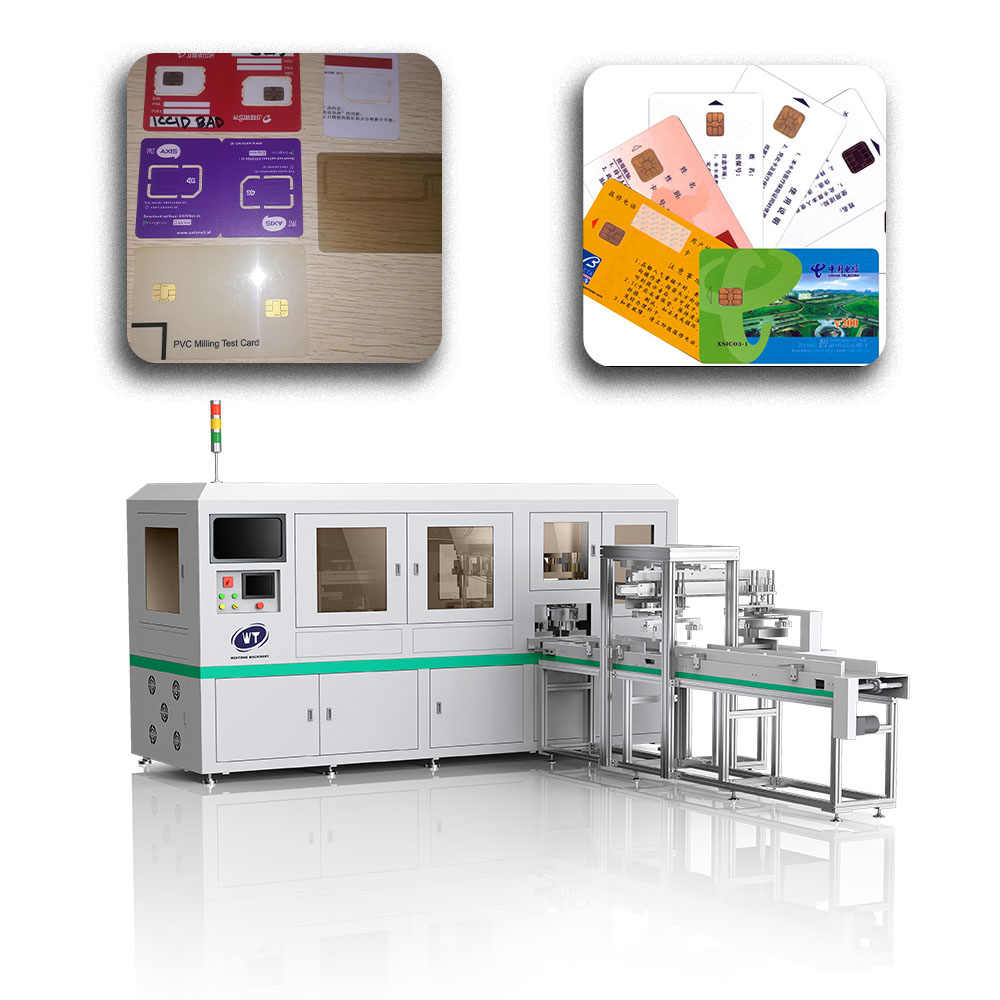
Traditional pneumatic stamping vs. modern servo hydraulic: Who is the future of smart card punching machines?
In the field of smart card production, the punching process has long been one of the most critical technological bottlenecks. Traditional smart card punching machines widely use pneumatic punching systems, which use compressed air as a power source to drive the punch through a cylinder to complete card cutting and punching operations. This technological route has dominated the mainstream over the past few decades due to its advantages of simple structure, rapid response, and low maintenance costs. However, as the precision requirements for RFID smart cards, dual interface cards, and various shaped cards (such as game cards, anime cards, bank cards, and celebrity cards) continue to rise, the inherent defects of pneumatic stamping systems are increasingly exposed. The pneumatic system relies on gas compression to transmit power and is greatly affected by pressure fluctuations in the gas source. Its pressure accuracy is usually only ± 10% FS, and the repeated positioning accuracy of the punching stroke can only be controlled at around ± 0.5 mm. Even more tricky is that the pneumatic system cannot adjust the output force in real-time according to changes in material thickness during the punching process, resulting in burrs, wire drawing, and even product scrap at the punching edge. For products such as smart cards, business cards, and playing cards that require extremely high card edge quality, this level of accuracy is far from meeting the needs of modern cardmaking technology.
The modern servo-hydraulic-driven intelligent card-punching machine has essential differences in technical architecture from pneumatic punching systems. The servo-hydraulic press adopts the “pump-controlled servo” technology, which directly drives the hydraulic pump with a servo motor. Through a high-precision closed-loop control system, the speed and torque of the motor are adjusted in real time, thereby achieving precise output of hydraulic oil flow and cutting pressure, completely eliminating the energy loss caused by high-pressure throttling in traditional “valve-controlled” systems. In terms of specific performance data, the servo-hydraulic-driven intelligent card punching machine can achieve a repeat position accuracy of ± 0.01 mm, which is an order of magnitude improvement compared to the ± 5% FS of traditional hydraulic presses and the ± 10% FS of pneumatic systems. The working cycle of the equipment can be stably maintained at 10-15 times per minute, with energy consumption reduced by 30%-70% compared to traditional models, operating noise reduced by 5-10 dB, and hydraulic system heat generation reduced to 10%-30% of conventional models. More importantly, the servo hydraulic system can adjust the punching power in real time according to the thickness and hardness of different materials such as paper, film, and soft magnetic film (a 7.5 KW servo motor provides power reserve), ensuring that each punching is completed with the best parameters and the finished product edges are smooth and free of burrs. For the common demands of “short, flat, fast,” and small-batch multivariety orders in the printing and business card printing industries, this equipment can complete order switching and machine adjustment within 15 minutes without the need for nailing or connecting points and can directly provide customers with sampling services—these characteristics make the servo hydraulic technology route an unquestionable future direction for intelligent card punching machines.
0.01mm Measurement: Precise Gap Control of Multi-cavity Punching Molds
The precision of multi-cavity punching molds directly determines the quality of finished products produced by intelligent card punching machines. In the design and use of multi-cavity molds, the consistency of gaps between each cavity and the deformation of the mold itself due to temperature changes are the two core variables that affect the punching accuracy. When a smart card cutting machine cuts multiple cards (such as business cards, game cards, playing cards, anime cards, etc.) from a large board at once, the cutting error of any cavity—even if it is only 0.01 mm—will result in inconsistent size specifications of the entire batch of products and even irreversible batch scrapping. Because the traditional pneumatic punch cannot compensate for the pressure of each cavity independently, some cards in the same first mock examination are cut continuously and some cards are cut excessively. This defect is especially fatal in the production of multiple cavities.
Modern smart card punching machines achieve precise gap control through multi-source sensor fusion and closed-loop feedback systems. The system collects real-time pressure data and position offset information of each workstation of the multi-cavity mold and dynamically adjusts the punching parameters of each cavity through adaptive control algorithms. When the ambient temperature or the temperature of the mold itself changes, causing thermal expansion and contraction, the system will automatically calculate the deformation compensation amount based on real-time feedback from the temperature sensor and accurately adjust the punching stroke through the servo motor. The accuracy of this real-time dynamic compensation mechanism can be controlled at the micrometer level, and the system’s repeated positioning accuracy remains stable within 0.05 mm. In addition, the device is equipped with a layout visual correction and positioning system (one of its features) that captures positioning marks on materials through high-resolution industrial cameras, detects and corrects X/Y biaxial deviations in real-time during the feeding process, and achieves high-precision position compensation in the plane. The step-by-step precise feeding mechanism with ball screw seamless transmission ensures the consistency and repeatability of the material’s position before entering each cavity of the mold. In terms of mold changing, the mold-changing time for wooden or lightweight materials is only 2-3 minutes, greatly reducing the waiting time for adjusting multi-cavity molds. Under the synergistic effect of these precision control technologies, even with multi-cavity one-time punching, the quality of the card edge of the finished product can be highly consistent—the edge is smooth without burrs, and the dimensional tolerance strictly complies with ISO/IEC international standards. The device supports two types of finished product collection methods simultaneously (sequential collection and classified collection) and can be connected to the backend product packaging to form a comprehensive solution, fully meeting the dual requirements of modern business card printing enterprises for accuracy and efficiency.
Thermal sensitivity and thickness difference: technical solution to solve antenna breakage in RFID smart card punching and cutting
The RFID smart card is embedded with antenna coils and chip modules, which makes its punching process much more complex and sensitive than that of ordinary PVC cards. Antenna breakage is one of the most common and difficult to completely solve adverse phenomena in RFID smart card production. The main reasons for antenna breakage are concentrated in two aspects: first, the thermal effect during the punching process causes deformation of the substrate, which compresses the antenna; second, the uneven thickness of the card material leads to local stress concentration, causing the antenna to be sheared or stretched. These two problems are often difficult to solve simultaneously on traditional pneumatic stamping machines or ordinary hydraulic presses, while servo-hydraulic-driven intelligent card-punching machines provide effective answers through a series of specially designed technical solutions.
From the perspective of thermal effects, RFID cards are usually made of thermoplastic materials such as PVC, PET, PETG, or ABS, each with its specific glass transition temperature and thermal deformation temperature. During the punching process, if the punching power system generates too much heat, or if the friction temperature rise between the mold and the card contact surface is too high, it may cause local softening or even melting deformation of the card substrate. When the antenna coil is compressed by the deformed plastic substrate, the connection between the copper wire antenna and the chip is prone to detachment or breakage, ultimately resulting in the inability to read and write the entire smart card. In response to this issue, the intelligent card-punching machine driven by servo hydraulics has natural advantages: the servo hydraulic system has extremely low motor speed or even complete stop during standby and pressure-holding stages, producing almost no additional heat, and the overall heat generation is only 10%-30% of conventional models. More importantly, the system can accurately control the cutting speed and downforce based on the thermal characteristics of the material—when cutting RFID cards with high thermal sensitivity, a low-speed, high-pressure mode is adopted to minimize the generation of frictional heat and protect the integrity of the antenna structure.
The difference in material thickness is another key factor. There may be slight thickness fluctuations in different batches or even in different positions of the same batch of card substrates, which are almost impossible to automatically compensate for in pneumatic cutting systems, often resulting in insufficient cutting force (cutting the card or antenna continuously) or excessive cutting depth (pulling the antenna or crushing the chip). Modern smart card punching machines use high-precision position sensors and pressure sensors to construct a closed-loop control system, which monitors the resistance and depth changes during the punching stroke in real time. When the system detects abnormal material thickness, it will adjust the downward pressure through the servo motor within milliseconds to ensure that each punching reaches the predetermined cutting depth accurately—completely penetrating the card without damaging the internal antenna. In addition, molds made of wood or lightweight materials are equipped with specialized chip avoidance groove structures, which keep the antenna and chip in a suspended protective state during the punching process, fundamentally avoiding physical contact between the punching parts and the antenna and chip. The device also supports sample making for customers, allowing them to verify the antenna integrity of RFID cards of different thicknesses and materials during the punching process during small-scale trial production. In actual production data, the intelligent card punching machine using the above technical solution can control the RFID antenna breakage rate below 0.05%, far lower than the 0.5%-1.2% level of traditional pneumatic equipment. At the same time, the material range applicable to the equipment covers various media such as paper, film, and soft magnetic sheets. In addition to various smart cards, it can also efficiently punch and cut card products such as business cards, playing cards, game cards, anime cards, bank cards, star cards, and small packaging boxes, truly achieving the production goals of multifunctionality and high precision.

conclusion
Based on the comparative analysis and practical data of the three technical aspects mentioned above, a clear technical conclusion can be drawn: although traditional pneumatic stamping systems still retain certain advantages in structural simplicity and initial purchase cost, they have significantly lagged behind servo hydraulic drive technology in terms of cutting accuracy, energy efficiency, yield, process adaptability, and ability to cope with thermally sensitive materials and thickness differences. For card categories such as RFID smart cards, bank cards, celebrity cards, game cards, anime cards, etc. that require strict requirements for antenna integrity and cutting-edge quality, servo hydraulic-driven smart card cutting machines have become an irreversible technological development direction.
Taking a multi-station intelligent card punching machine equipped with 7.5 KW servo cutting power as an example, its core technical indicators are as follows: The repeated positioning accuracy reaches ± 0.01 mm, and the system’s repeated positioning stability is controlled within 0.05 mm; The work pace is stable at 10-15 times per minute, and the energy consumption is reduced by 30%-70% compared to traditional models. The time for mold change and machine adjustment can be compressed to within 15 minutes (only 2-3 minutes for wooden or lightweight molds); Punched products do not require nailing or connecting points, and the edges of the finished product are free of burrs, with positional accuracy meeting international standards; Finished product collection supports two modes, sequential collection and classified collection, and can be connected to backend product packaging to form an overall solution. The equipment is suitable for various materials such as paper, film, and soft magnetic sheets and is widely used in the production of card products such as smart cards, business cards, game cards, playing cards, anime cards, bank cards, celebrity cards, and small packaging boxes. In actual production verification, the intelligent card punching machine using servo hydraulic drive and mold compensation technology can control the RFID antenna breakage defect rate below 0.05%, achieve a quality consistency of over 99.8% for finished card edges, and improve order switching efficiency by more than three times compared to traditional models. These data fully demonstrate that in the field of multi-station intelligent card punching machines, the combination of servo hydraulic drive technology and precision mold compensation technology is steadily replacing traditional pneumatic stamping and becoming the core force driving precision upgrades and efficiency revolutions in the business card printing industry. For printing and business card printing enterprises, choosing a servo-hydraulic intelligent card punching machine with features such as visual correction positioning, step-by-step precise feeding, fast order switching, and thermal-sensitive material adaptation is a rational technical decision to enhance product competitiveness, reduce production losses, and respond to market demand for small batches and multiple products.