How to achieve rapid mold change for card punching machines that produce irregular cards and multi size board game cards?
blog 2026-06-29 20:37:02 20
In the card printing and processing industry, the punching machine is the main equipment for the final product shaping. The equipment is widely used in the production of cards, smart card, business card, game card, playing card, anime card, bank card, star card and other cards. The market demand for customized products such as irregular cards and board game cards is rapidly increasing. The challenge for printing enterprises is no longer single-batch production, but how to maintain efficient output in a multi-variety, small-batch order model. Especially in the European and American markets, customers like to place small batch trial orders and iterate quickly, which requires the production equipment to have extremely high adaptability and switching efficiency. This article analyzes how a highly versatile punching and cutting machine can rapidly switch large span sizes from 54 × 54 mm to 210 × 210 mm from three technical dimensions: equipment adjustment, mold structure design, and tool mold customization. The machine can control the mold replacement time within 15 minutes, and balance punching accuracy and finished product quality.
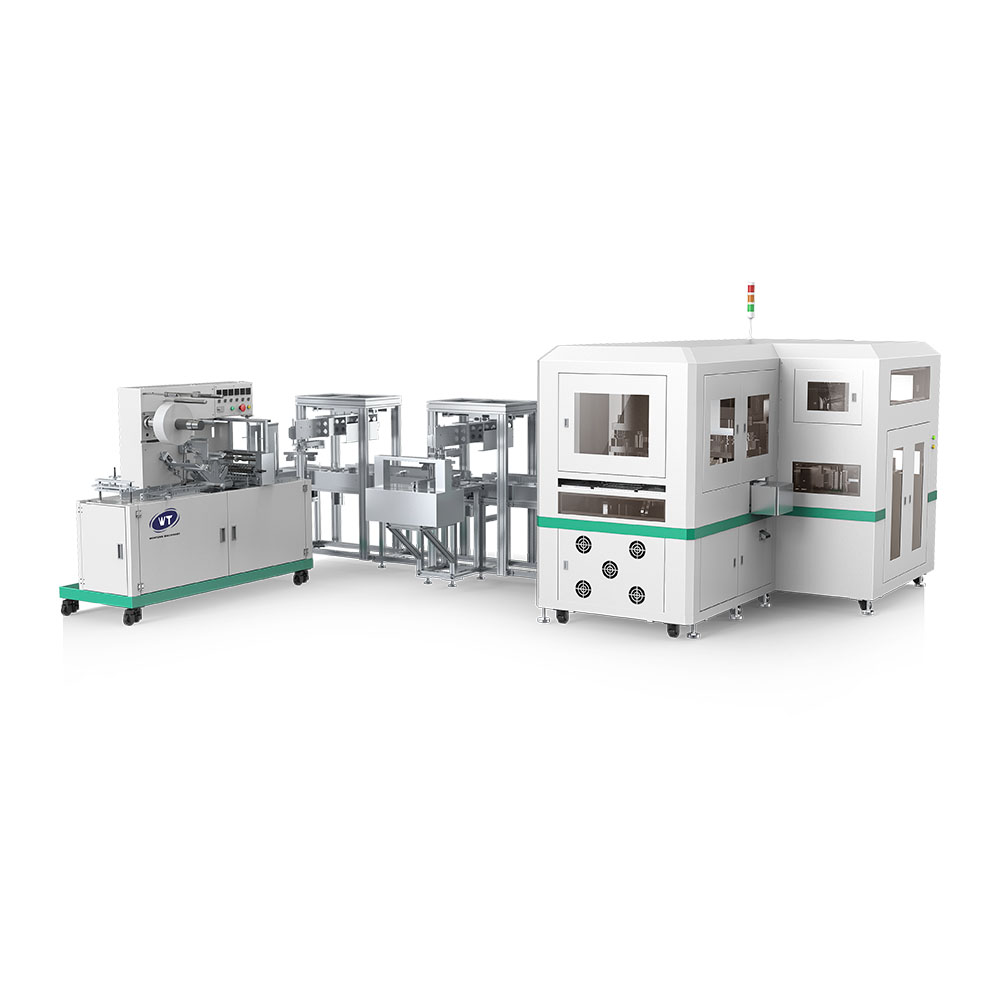
Fast methods for adjusting the large span dimension punch cards.
The efficiency of machine adjustment determines whether the equipment can follow the production rhythm of multiple orders for a punching machine that needs to punch 54 × 54mm small smart cards and 210 × 210mm large board game cards at the same time. In switching between products with large size spans, traditional punching machines usually need several hours to readjust feeding parameters, positioning benchmarks, and punching strokes. The modern high-performance punching machine adopts the step-by-step precise feeding system to solve this problem. The step-by-step feeding is driven independently and controlled by the servo system, and the feeding accuracy can be stable within ±0.02 mm. The operator only needs to input the size parameters of the new product on the touch screen, the system can automatically calculate and implement the corresponding feeding step distance, without manual adjustment of the mechanical stopper or eccentric wheel, fundamentally eliminating the material waste caused by manual cutting.
The other significant adjustment assistance technology is the layout visual correction and positioning system. The high resolution camera detects the positioning marks on the material in real time, calculates the deviation of the material from the reference position via image comparison, and feeds back the correction commands to the feeding system. The total correction response time is less than 0.1s. This makes it no matter how big the lamination deformation and position deviation is before the material enters the punching machine, the vision system can make accurate correction before punching, so that the punching contour of each of the first mock examinations is completely coincident with the printed pattern. It is worth mentioning that the device does not need to reserve nail holes or connection points on the product during the process of adjusting the machine, saving subsequent sorting processes and avoiding edge burrs caused by tearing of connection points. In actual production, the whole process of adjusting new size parameters to confirm the first finished product can be completed within 15 minutes. This greatly reduces the equipment downtime waiting time and greatly improves the equipment utilization rate for printing companies that often receive from 50 to 500 short version orders.
To reduce the time for card punching machine mould replacement within 15 minutes.
If tuning is a quick reaction on the software side, then changing a mold is an efficiency challenge on the hardware side. In typical die-cutting equipment, it is often necessary to remove a lot of template and change the distance between the upper and lower molds. Changing a set of molds takes more than 20 minutes. The structural design of the quick change mold is based on the idea of standardizing and modularizing the mold, and changing the clamping method from “screw fastening” to “groove positioning + quick locking”. This design not only can reduce the number of manual operation steps, but also avoid the mold deformation caused by the uneven locking force, so as to extend the service life of the mold.
The modern quick-change mold frame simplifies the traditional 8-template mold to 4 to 5 plates, and adopts the sliding groove method for quick demolding and assembly of the mold and mold frame. The operator only needs to push the mold into position along the sliding groove, and then the positioning and clamping will be completed on the rotary lock part or hydraulic locking device. Total time is only 2-3 minutes. Some advanced punching machines are also equipped with a mold-changing guide system, which can place new and old molds on both sides of the equipment workbench, achieving a streamlined mold-changing process of “pushing out one set and pushing in one set”, further reducing equipment downtime. For punching machines using lightweight wooden molds, the speed of changing molds can be improved further. The wooden mold is light in weight and convenient to carry. Besides, the quick-change mold frame adopts a sliding groove structure, and the time for one mold change can be controlled within 2 to 3 minutes. This means that even if there are 5 to 6 different sizes or shapes of card orders to be switched within a day, the total mold change downtime of the equipment can be controlled within 15 minutes, which is a technical indicator with practical production significance for printing and processing enterprises that mainly operate in small batches and multivariety orders. Meanwhile, the device also meets the customer’s requirements for sampling. After sample confirmation, it can be directly transferred to mass production without secondary debugging, truly achieving the seamless transition from “sampling to mass production”.
Precautions for the customization of non-standard rounded (R-corner) game card punching machine dies
Game cards, board-game cards and other products usually require a higher degree of corner roundness than ordinary cards. One of the most common technical requirements in knife mold making is to customize non-standard R-corners. The first thing to clarify when customizing the die of the punching machine is the radius size of the R angle and transition curve type. Every game has a different expectation for the feel of the cards and the experience of shuffling. Some prefer larger R-angles (R5-R8) for a rounded feel, while others prefer smaller R-angles for visual sharpness. The manufacturer of knife molds needs to accurately process the blade curve corresponding to the R-angle curvature according to the CAD drawings or physical samples provided by the customer. Generally, the carving die is made of the whole piece of steel CNC machining, and its R-angle transition smoothness is much better than etching die, which is more suitable for the production of board game cards with higher requirements for edge quality.
The cutting quality is directly affected by the material and machining accuracy of the blade. High-precision cutting dies can be made with a dimensional tolerance of ± 0.03 mm, the blade height can be machined up to a maximum of 5 mm depending on the thickness of the material to be cut and the blade angle can be adjusted between 30 and 60 degrees. For different materials like paper, film, and soft magnetic film, the blade angle and the height of the cutting die should be adjusted accordingly, the thicker or harder the material, the blade angle should be increased appropriately to improve the cutting force. The thinner or softer the material, the smaller the blade angle should be to prevent tearing of the material. And the degree of the punching power of the punching machine is 7.5KW servo motor, which has the large cutting torque and high accuracy, so that the cutting die is uniformly stressed when punching process. It guarantees a clean cut edge without burrs, even with hard cards of 0.8 mm thickness or soft magnetic sheets of 0.3 mm thickness. In the acceptance process of non-standard R-angle cutting dies, it is recommended that printing companies pay attention to three indicators: first, the smoothness of the edges and corners of the cards after punching, whether there are burrs or jagged edges; The second is the consistency of the R angle of the same batch of cards, whether there are size fluctuations caused by tool wear or installation deviations. 3. Life span of the cutting die. The life of the carving die is usually more than 3 times of the etching die due to the high hardness of the material (HRC54-60). In the mode of small batch and multi-variety production, it is suggested that enterprises should establish the standardized interface protocols with die suppliers, so that dies of different R-angle specifications can be quickly installed and positioned on the same punching machine. Then the die replacement can be included into the whole rhythm of “15-minute die replacement”.

Summary
The analysis of the above three technical dimensions shows that the highly versatile punching machine can achieve rapid mold change production in a large span size range of 54 × 54 mm to 210 × 210 mm, with three major technical supports: rapid adjustment system, including step-by-step precise feeding and visual correction positioning (feeding accuracy ± 0.02 mm, correction response < 0.1 seconds); rapid mold change structure, including sliding groove rapid change mold frame and lightweight molds (mold loading and unloading takes 2-3 minutes); tool mold adaptation system, including high-precision customized tool molds and standardized interfaces. In actual production, the total time from mold change shutdown to resumption of production can be controlled within 15 minutes, and the process of mold loading and unloading only takes 2 to 3 minutes. The punching machine has the functions of accurate feeding, automatic collection and waste removal. The finished product collection supports two modes: sequential collection and classification collection – the former is suitable for standard packaging lines, and the latter is easy to classify by grade or color, and can be connected with the backend product packaging overall solution. This means that equipment for printing enterprises for the European and American markets can flexibly respond to different order requirements from small batch sampling to mass production, guaranteed cutting accuracy (positioning accuracy ± 0.02 mm, repeated cutting positioning accuracy ± 0.01 mm), burr-free product quality and greatly reduce down time costs caused by switching orders. Real test data shows that for equipment working under the 8-hour working system, the overall equipment efficiency (OEE) can be improved by about 30% compared with traditional models through 6 mold changes, and the cumulative downtime does not exceed 90 minutes, thus creating a higher return on investment for printing and processing enterprises.