How does PVC card punching machine solve the problem of white edges and cracks in punched plastic cards
blog 2026-06-10 23:53:48 20
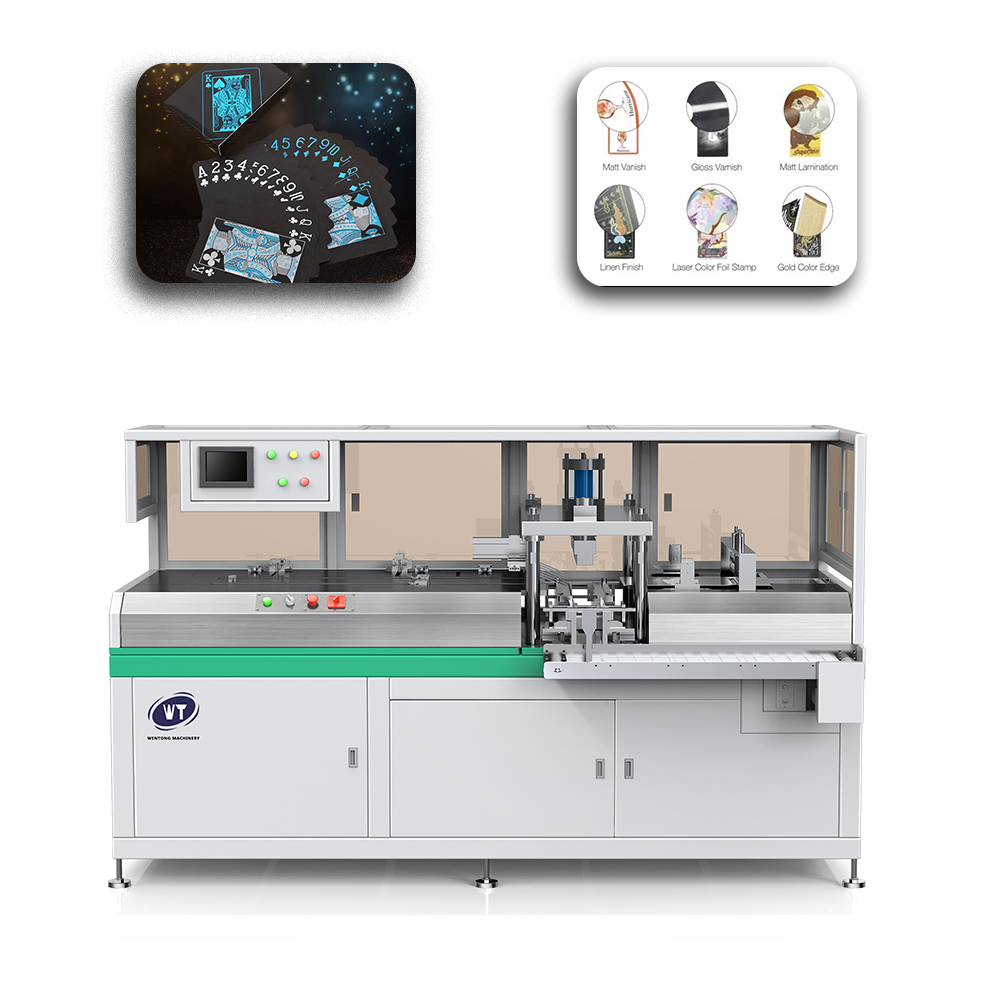
Mechanical differences in the formation of fracture layers between paper fibres and rigid polyvinyl chloride (PVC)
The mechanism of punching and cutting fracture of paper is essentially different from that of PVC plastic, which is a fundamental prerequisite for understanding the issues of white edges and cracks. Paper is made up of intertwined plant fibres that have spaces and hydrogen bonds between the fibres. The fracture of this material shows the staged nature of “fiber pulling interface delamination fibre fracture”. When the punching tool cuts into the paper, the fibre gradually separates under the shear stress, and the fracture layer extends along the fibre gap, which forms a relatively continuous and flexible fracture boundary . Therefore, the paper is seldom suffered from the edge breakage or the white edge problem during punching. In contrast, PVC is a thermoplastic polymer with a linear chain molecule structure that is hard and brittle below the glass transition temperature. In the process of punching, it is subjected to high-speed impact shear, and cracks quickly propagate in the direction of stress concentration. The fracture layer has a smooth cross-section, but its edges are prone to radial microcracks and white stress whitening areas, which are essentially caused by the aggregation of silver lines and micropores generated by PVC during plastic deformation. Further studies have indicated that the impact strength of PVC varies non-linearly with strain rate, and the fracture mode changes from ductile tearing to brittle splitting at high strain rate, which is the micro-mechanism of the high incidence of the white edge phenomenon. Based on a deep understanding of this basic physical difference, the high-precision card punching machine is powered by a 7.5 kW servo motor. Servo control accurate die-cutting curves, stepped punching speed adjustment, and mould microgap compensation control the punching stress distribution within the elastic limit of PVC, fundamentally avoiding cracks and white edges caused by stress concentration, and presenting a smooth and flat punching edge without burrs.
Influence of mould heating assistance system and punching speed on the smoothness of edges of composite materials
The hard PVC cards show typical brittle fracture features at room temperature, and the edges are susceptible to chipping and burr during punching, which is directly related to the inadequate low-temperature impact toughness of the cards. The confirmed technical route of processing high calcium PVC materials is to soften the material by appropriate preheating time intervals, which can effectively eliminate the cutting edge breakage and gaps, and greatly improve the product qualification rate. The basic principle of the mould heating assist system is that when the mould temperature is higher than the glass transition temperature of PVC (about 75-85 ℃) and lower than the melting temperature (about 160 ℃), the PVC molecular chains are more active, and the material is changed from brittle fracture to ductile fracture. The distribution of stress in punching is more uniform, and the micro cracks and white stress zones at the edges are significantly reduced. Experimental data show that the width of the white edge of the punching edge of PVC cards can be reduced from 0.15 mm at room temperature to below 0.03 mm in the temperature range of 80-90 degrees C in the mould. Meanwhile, the control of punching speed is also very important. Research has shown that the loading rate has a direct impact on the tensile and bending properties of PVC materials. If the punching speed is too high, it will cause the phenomenon of “stress relaxation”, which will cause the fracture layer to become unstable and expand rapidly. Advanced card punching machines are equipped with servo-motors for the dynamic stepped adjustment of the cutting speed. In the cutting stage, low-speed entry (~15mm/s) is used to form a stable cutting zone, while in the penetration stage high-speed punching (~80mm/s) is used to reduce the material extrusion deformation. The smoothness of the edges of different card materials after punching can be improved to the level of transverse burrs≤15 μ m and longitudinal burrs≤12 μ m by adjusting the heating and speed dual parameters.
Custom tuning of stamping tooling parameters PET, ABS and anti-static materials
As the card material has increased from single PVC to PET, ABS and even anti-static composite materials, punching machines need to have the ability to change tool parameters to accommodate the elastic plastic characteristics of different materials. The impact strength of PET material is about 3-5 times higher than other commonly used materials and the flexural performance is extremely excellent. At the same time, ABS cards are significantly more durable than PVC. Different materials fracture mechanisms require differentiated clearance fit, shear angle and state of cutting edge of cutting tools. In engineering practice, the quality of punching is mainly affected by the setting of tool clearance. For the high modulus, high rebound rate materials such as the PET and anti-static ABS, the tool gap must be reduced to a range of 0.008 mm to 0.015 mm to induce an instantaneous shear fracture rather than a pull-out delamination fracture. For the excellent toughness of ABS cards, the cutting edge of the tool should have better wear resistance and anti-chipping ability in the punching process. The mould steel should be forged and hardened to HRC 60 and above to resist the impact wear from high-frequency punching. In addition, the problem of generation of frictional electricity should also be considered for anti-static materials. In real production, the coefficient of friction and static electricity accumulation can be reduced by using cutting tools coated with diamond-like coatings on the surface. The core value of the punching machine in tool calibration lies in the preset and replaceable sets of tool parameter schemes, which allow the same equipment to quickly adapt to the punching needs of different materials such as PVC, PET, ABS, and anti-static without disassembling screws, and truly realise the flexible production of multiple materials on one machine. The time for changing wooden light weight moulds is only 2-3 minutes, thus greatly reducing waiting time between different orders.
Control of physical dimension and perpendicularity of edges to international smart card ISO standards.
The international smart card ISO/IEC 7810 standard has strict specifications for the external dimensions and edge perpendicularity of the card. In the punching process, it is required to ensure the synchronisation of three sets of parameters: the deviation of the card outline dimension is less than ±0.1 mm, the deviation of the edge and surface perpendicularity is not more than ±0.02 mm, and the cutting surface must not have inclined or wavy defects. ISO/IEC 7810:2003 standard ID-1 card: A card of size 85.60mm × 53.98mm with a nominal thickness of 0.76mm. This is an international standard for the smart card industry, and any deviation in size will directly affect the parsing performance of the card and electromagnetic compatibility in automatic card reading devices. This dimension of the card punching machine’s technical support system consists of three links, the first of which is the layout visual correction positioning system, which detects the card layout marks in real time via industrial cameras and controls the correction accuracy in the horizontal direction to ± 0.2 mm; Secondly, the step-by-step precise feeding system steadily advances the large plate material with the feeding accuracy of ± 0.15 mm per step, without the need of nailing or connecting points to complete die-cutting. Thirdly, the four-column synchronous balance punching mechanism makes sure that the relative parallelism between the upper worktable and the lower worktable is stable during movement, and prevents the edge tilting caused by single-column overshoot. The equipment integrates these three technologies via PLC and servo control system, and the dimensional accuracy and edge perpendicularity of each finished card can be checked by ISO standard measurement. The accuracy of the finished product position is held to the level of horizontal ± 0.1 mm and length ± 0.05 mm. It can also support two kinds of finished product collection, sequential collection or classified collection, and can be connected with the backend product packaging overall solution to meet the one-stop needs of customers from punching to packaging.
Conclusion
The comprehensive technical analysis of the above four aspects shows that the systematic solution of the PVC card punching machine to solve the problem of white edge and cracks has sufficient engineering empirical basis. The main data are: Feeding accuracy ± 0.15 mm, punching accuracy controlled within ± 0.1 mm in the horizontal direction and ± 0.05 mm in the length direction, the upper limit of punching burrs is ≤ 12 μm in the vertical direction and ≤ 15 μ μm in the horizontal direction. The visual correction accuracy can reach ± 0.05 mm, and the step-by-step feeding system can ensure the stability and repeatability of each feeding step. The rated torque of the 7.5 KW servo motor is designed for the maximum load condition with the design margin of 10% to 20%, which can drive the four-column synchronous punching mechanism to work efficiently. The gap of the mould blades is strictly controlled between 0.008 mm and 0.015 mm to ensure the card edge is smooth, flat and free of burr. The comprehensive effect of the above technical parameters, the die-cutting machine can be maintained in full load production conditions of die-cutting cycle of 25-32 times/minute. The equipment is widely compatible with PVC, PET, ABS and various anti-static card materials, and can also be used for the production of card sheets and small packaging boxes made of paper, film, soft magnetic sheets and other materials. It should be pointed out that the solution to the white edge and crack problems is not a single technical means, but the joint action of multiple technical modules such as visual correction system, precise feeding mechanism, 7.5kW servo power system, precision mould configuration and finished product collection system. This is exactly the above-mentioned system of technology, which is layer by layer and mutually protective, that enables the punching machine to always and reliably make finished cards that meet the international standards of smart cards, providing professional and efficient die-cutting solutions for the global printing and card-making industry. The data of practical application shows that the nonconformance rate caused by white edges and cracks of customers after adopting this equipment can be reduced within 0.5% from 3% to 5% in traditional punching and cutting process. The switching and adjusting time of a single order is only 15 min, which greatly improves the production flexibility and profitability of small batch and multivariety orders.