Daily precision grinding and preventive maintenance system for a fully automatic industrial punching machine
blog 2026-06-10 00:15:59 12
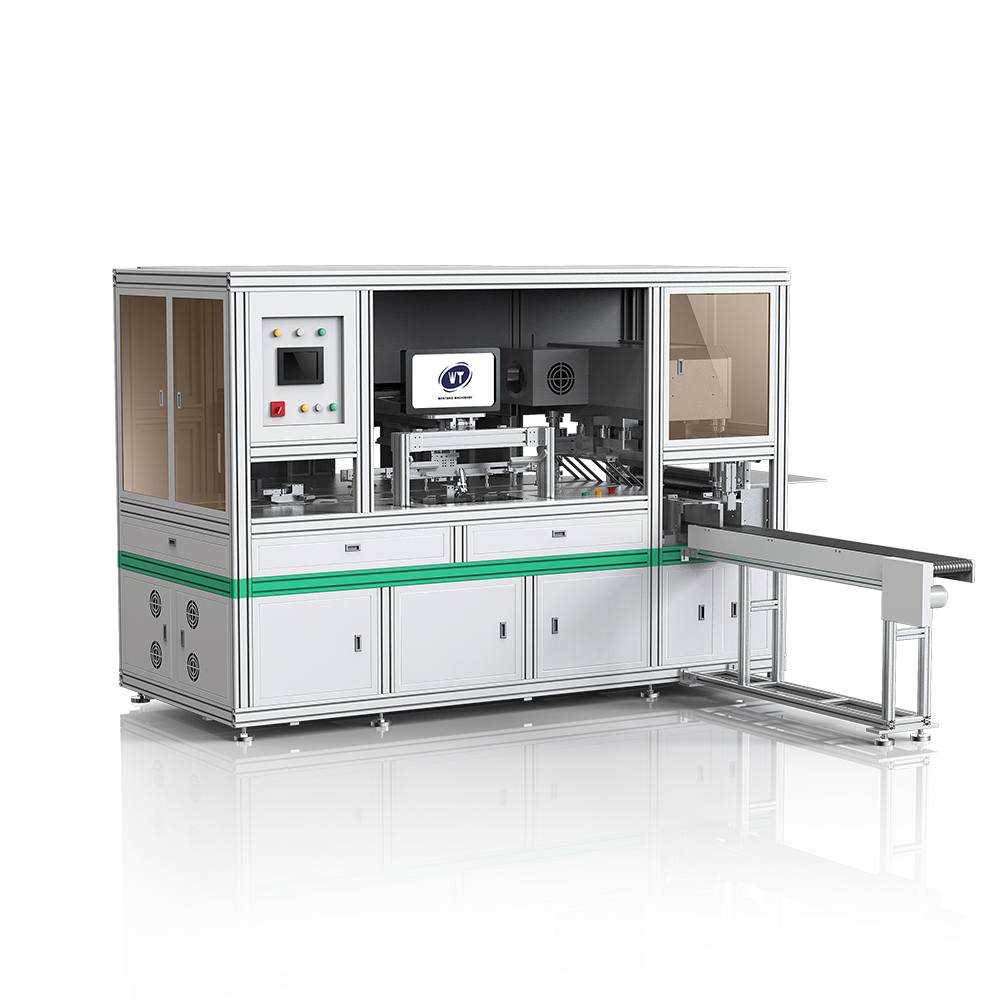
Judging Tool Passivation Through the Micro morphology of the Edge of the Finished Card Mould wear characteristics
In the punching production of card products such as smart cards, SIM cards, bank cards, game cards, playing cards, anime cards, celebrity cards, business cards and so on, the edge quality of the finished card is the most direct window to judge whether the punching machine mould is healthy or not. The sharper the edges of the punch and the die are, the more obvious corner collapse regions, bright regions (50%-70% of the thickness), fracture regions and very small burrs (height ≤ 0.05 mm) on the cut surface are. When the cutting edge is passivated, the width of the burr will be greater than 0.1 mm, and the cross section will have brushed or single-sided burrs and even corner cracks. Randomly check 5000-10000 of the finished products with 30x stereomicroscope. In the case where the cracks and the rounded edges of radius 0.05 mm or more are reached R0.1 mm , it can be determined that the mould entered the passivation stage . Grinding should be planned within 24 hours. Usually the scrap rate has increased to over 0.2% at this time. If the card manufacturers can provide early warning by microscopic morphology and control the grinding time in the early stage of micro fracture, the single-pass qualified rate can be stable above 99.5%.
The layout visual correction and positioning system equipped on the punching machine can help determine the wear condition of the mould: when the positioning mark on the finished card deviates from the punching contour by more than ± 0.1 mm, in addition to checking the feeding accuracy, the mould blade edge should also be sampled and tested. For PVC or paper-based material, when the thickness is 0.3-0.8 mm, the proportion of bright edge after punching is less than 40% , it can be considered as the threshold of edge passivation. The establishment of a daily warning mechanism through edge micro-morphology can reduce unplanned downtime by more than 25%, which is particularly suitable for the multi-variety and small-batch production mode in the Indian market.
Standardised process for practical operation of precision surface grinder for grinding the cutting edge of punching machine mould
The most reliable way to grind the cutting edge of the punch die of the card punching machine is to use a precision surface grinder with a special fixture. The grinder can control the parallelism and flatness of the punch and die to IT5~IT6 level accuracy (0.005-0.01 mm) and the surface roughness can reach Ra 0.4 μm or less. Before the grinding, the mould needs to be cleaned thoroughly to find out the depth of the fracture is greater than 0.5 mm . The punch should be clamped vertically in the V-shaped groove of the magnetic chuck, and the side busbar runout should be calibrated with a dial gauge to be ≤0.005 mm. Use a white corundum or CBN grinding wheel with particle size of 100-150, feed rate of 0.002-0.005 mm at a time and line speed of 35-45 m/s. Do not use water-based coolant. It will cause annealing of the blade. Strictly control the grinding of the concave mould, the ratio of the grinding frequency of the punch and the lower mould is recommended to be 4:1.
After each grinding more than 20 pieces must be tested with standard materials to check the uniformity of burrs and dimensional tolerances (allowed ± 0.05 mm). The total grinding amount of a single punch should not exceed 0.3 mm, otherwise a new punch should be replaced. Compared with 800,000 times, standardised grinding can extend the service life of a punch to more than 2 million times after one grinding, and reduce the mould maintenance cost by about 60%. For the lightweight moulds of punching machines commonly used (the mould change takes only 2-3 minutes), recording the amount of grinding and the subsequent stamping times after each grinding can gradually optimise the maintenance cycle, so that the equipment can maintain stable punching quality in the case of rapid order switching.
Lubrication, lockup, and air path check prevent equipment from eccentricity due to loosening of the mechanism under high speed continuous impact.
The punching machine is subjected to high-speed impact of 60-120 times/min, the guide rail, screw, bearing and fasteners tend to loosen, deviation of the punching centre line and the mould centre line is caused, reflected in uneven burrs on the four sides of the finished card or offset punching position. Three system checks are required before daily start-up: lubrication system Inspect the oil storage of the automatic lubrication pump (ISO VG68 guide rail oil) and check whether the oil discharge of each oil distributor is normal. Locking system Tighten punch fixing bolts, mould bottom plate bolts and guide rail pressure bar bolts with torque wrench as per standard (M10 bolts: 40-50 Nm). Apply a medium-strength thread locker to critical screws on a weekly basis to prevent loosening. Check whether the gas source pressure in the pneumatic system is stable at 0.5-0.7MPa. Check whether the oil mist drips 2-4 drops per minute. Check whether the vacuum adsorption pressure reaches -60kPa or above.
The parallelism of the installation surface of the punching machine mould should be calibrated at least once a month. The flatness of the upper and lower mould seats is measured by a dial gauge, and the parallelism should be ≤ 0.03 mm. If it is greater than the tolerance, then readjust the copper gasket between the lower mould seat and the bed body. The clearance between guide column and guide sleeve is controlled within 0.01-0.02mm, if radial runout >0.02mm, it needs to be replaced. Strict implementation of the inspection system can reduce the eccentricity failure rate of the equipment by 70%, and major repairs are only needed after continuous operation of more than 2 million times. To guarantee the long-term stable operation of the punching machine in the high temperature and dusty environment, e.g. India, it is recommended to shorten the lubrication replacement cycle to 2 months and add a 0.01μ μm precision filter to the air path.
Creation of the digital archive of equipment: Predictive maintenance by stamping times
Transition from corrective to predictive maintenance of the punching machine by the creation of a digital archive for each device and the use of the real punching frequency as a key indicator for maintenance decisions. The daily cumulative punching times, mould grinding times, lubrication and maintenance cycles and other data can be automatically recorded with a PLC control system. The first blade inspection of the mould is determined at 50000 times, and then modified to 80000-150000 times. After 8 million times of accumulation , check the reverse clearance of the ball screw ( if it is greater than 0.02 mm , it needs to be replaced ) . Monitoring of bearing vibration by acceleration sensor . When the RMS value exceeds 20% of the initial value , an alarm will be triggered . Over grinding (30% reduction in total life of the mould for every 100,000 times of grinding) and under maintenance (grinding only when the burr is obvious, resulting in 5%-10% waste) can be effectively avoided with digital archives.
The mould change time, machine adjustment parameters and trial punching pass rate for each order switch should also be recorded in the punching machine’s digital file. The change of mould only takes 2-3 minutes, and the order switching can be done within 15 minutes with the help of a general parameter library. For foreign customers, we can provide a local or cloud-based data recording system, which can automatically push maintenance reminders (for example, “Mould A001 has accumulated 150000 times, please check the cutting edge”). Practical applications have demonstrated that manufacturers utilising digital archives for predictive maintenance can cut unplanned downtime by more than 40%, reduce full lifecycle maintenance costs by around 25% and decrease the frequency of mould replacement by 30%. The stamping frequency data can also be used to accurately calculate cost of a single item, providing the data support for bidding large orders.
wrap up
The precision grinding and preventive maintenance system of the fully automatic industrial card punching machine is a scientific management method based on data. The statistical analysis of 2 million molds’ service life and the production of more than 10000 pieces of finished products shows that the card production enterprises that strictly follow the four-step process of “edge morphology judgement wear – grinding machine standardisation repair – three system point inspection – digital file management” can punch and cut more than 2 million moulds stably after one grinding and keep the product qualification rate of more than 99.8%. The continuous fault-free operation time of the equipment has been extended from an average of 4.5 months to more than 10 months, an increase of 122%; The loss of bulk waste due to equipment eccentricity or blade passivation is reduced to about 35%. The annual reduction of waste losses is approximately 65000 cards based on an annual production of 5 million smart cards, and a direct economic benefit of over 20000 US dollars.
The cost of using a precision grinder for grinding a set of moulds is about 15-25 US dollars, and the cost of replacing a new mould is 300-600 US dollars. Four rounds of grinding can save about 500 US dollars for the whole lifecycle. A 10-minute daily inspection costs about $200 per year in labour and can save thousands of dollars in mould damage in one operation. The upfront cost of creating a digital archive system is about $500-1000, and the investment is usually recovered within 3 months due to decreased downtime and waste. The punching machine equipment manufacturers can bring to customers in the global smart card, bank card, game card, playing card, anime card, and business card markets, as well as paper cards and soft magnetic sheets, is not only a high-performance punching machine that can achieve accurate feeding, automatic collection, waste removal, visual correction, step-by-step feeding, no nailing or connecting points, support for fast sampling, and 15-minute order switching, but also a validated and data-supported maintenance system that helps customers significantly reduce production costs and improve product quality consistency in overseas markets such as India.