How can the anime card punching machine solve the problems of burrs, misalignment, and scratches in anime card production?
blog 2026-05-29 00:31:22 8
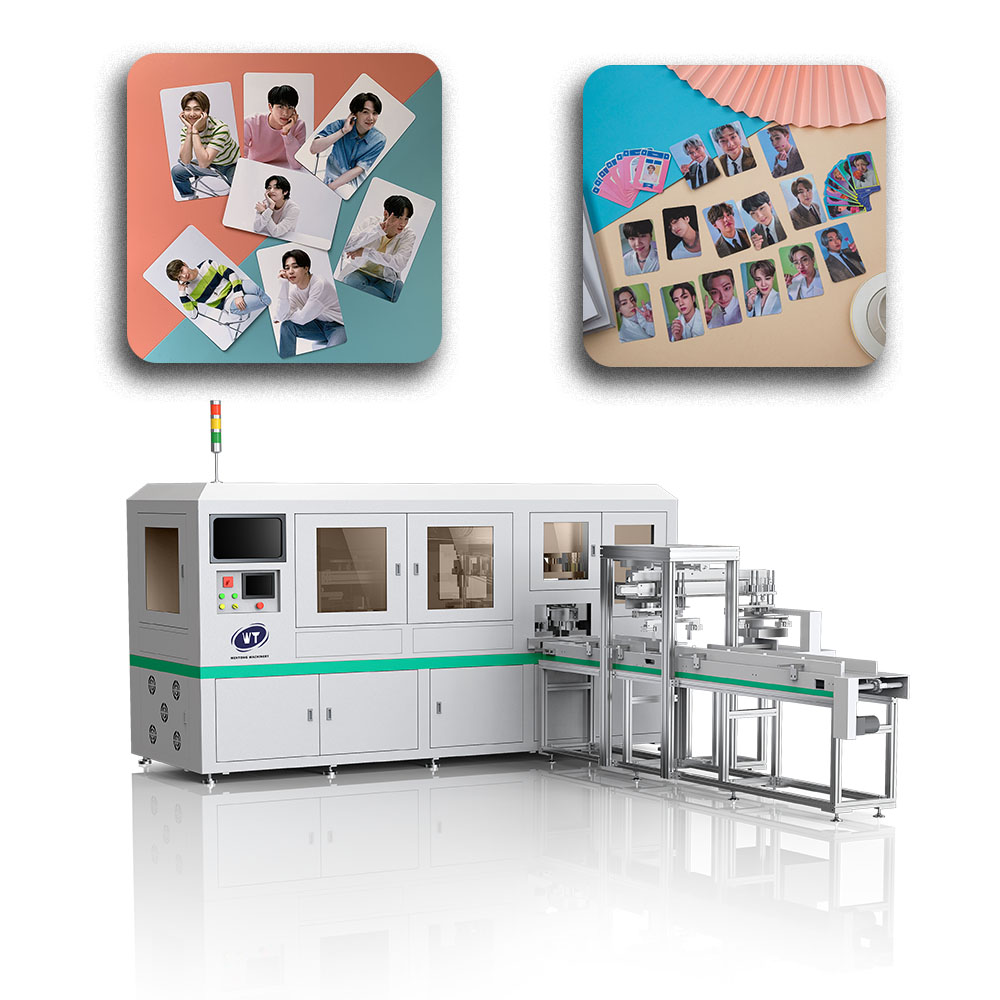
During the production of products such as anime cards and smart cards, burrs, misalignment, and scratches on the card surface are considered the three core defects. These three defects not only affect the appearance of the card but also directly lead to the failure of smart card reading or batch scrapping. This article will deeply analyse the root causes of these problems from three technical dimensions: punching principle, surface protection, and visual guidance and explain how the new generation of anime card punching machines (also known as die-cutting machines) have completely overcome these technical bottlenecks through precision mechanical design and intelligent correction.
Root cause analysis of burrs: geometric principles of punching gap and mould wear
The root cause of burrs or edges generated during the punching process of anime cards is that the punching gap between the convex and concave die edges has not reached the optimal geometric state. From the perspective of material fracture mechanics, the separation process of sheet metal can be divided into three stages: elastic deformation, plastic deformation, and fracture separation. When the gap between the convex mould and the concave mould is set appropriately, the cracks generated at the upper and lower cutting edges will precisely coincide at the centreline of the plate, forming four characteristic areas: rounded corner zone, bright zone, tear zone, and burr. At this time, the cross-sectional quality is most ideal, and the burrs are minimal. However, when the gap is set too small, the cracks generated at the concave die edge will shift inward and point towards the high-pressure stress zone below the convex die, causing the cracks to fail to converge properly. The sheet is forced to undergo a second shear, resulting in a residual fracture zone and elongated burrs in the interlayer between the two bright bands. On the contrary, when the gap is set too large, the material is mainly subjected to bending and stretching, and the proportion of bright bands is greatly reduced. This not only increases the slope of the tear band but also produces larger and thicker burrs, and the verticality of the cross-section is severely reduced. Due to the use of multi-layer composite structures (such as PVC substrate, PETG film, etc.) in anime cards and smart cards, once the mould wears and causes the gap to deviate from the reasonable value, the generation of burrs is almost inevitable.
In response to this geometric challenge, the anime card punching machine, specifically designed for small and medium-sized markets, introduced a high-rigidity die-cutting power system and a modular lightweight wooden mould structure from the beginning of its design. The equipment is equipped with a 7.5KW servo cutting power system as standard, which can provide continuous and stable downward cutting force for the mould, ensuring that the plate is evenly stressed during each cutting and avoiding edge cracks and deviation caused by force fluctuations. More importantly, the device is compatible with a quick replacement mechanism for lightweight wooden moulds. The mould body adopts a lightweight wooden structure, and the overall mould replacement time only takes 2-3 minutes. When used for punching cards of different thicknesses or materials (such as bank cards, game cards, star cards, etc.), operators can flexibly select specialised moulds with preset optimal single-sided gaps according to the specific thickness of the board and quickly replace worn cutting edges. Due to avoiding the problem of excessive clearance caused by long-term heavy load punching in traditional steel moulds, this feature fundamentally eliminates the occurrence of secondary shearing from a geometric perspective, ensuring that the card edges are free of burrs and the smoothness meets or even exceeds the quality standards of printed materials.
What should I do if there is a scratch on the card surface? Surface protection scheme for air flotation conveying and soft suction cups
In the complex logistics process of card feeding, punching, and stacking, scratches on the card surface are often a high-incidence problem that affects product yield. For high-end printing factories that produce star cards, QR code smart cards, and laminated playing cards, any slight scratch can lead to rejection of high-end orders. Traditional punching machines often use roller conveyors or belt friction feeding methods, which transmit driving force through solid contact. Under high pressure and relative motion, these methods are prone to leaving difficult-to-repair physical scratches on the surface of the product. With the increasingly complex surface technology of anime cards (including hot stamping, UV varnish, frosted layer, and even 3D stereoscopic images), the traditional rigid contact feeding mode can no longer meet the demand for high-quality production.
In response, modern anime card punching machines have introduced air flotation conveying technology in the conveying process, completely subverting the way cards move inside the machine. By uniformly arranging connected exhaust holes on the precision air flotation plate of the conveying platform and introducing high-pressure gas, these exhaust holes instantly form a thin, rigid, and surface-stable air film (air cushion layer) on the bottom surface of the card. When the card is between the first and second air flotation plates, the high-pressure gas injected in opposite directions stabilises the card in an equilibrium position, ensuring that the entire card has zero contact and no friction with physical mechanical components during transmission. At the same time, at the positioning execution end of the punching station, the equipment has abandoned the traditional hard metal robotic arm and instead equipped it with a soft vacuum suction cup. When the step-by-step feeding structure transports the card to the designated station, the soft suction cup gently adheres to the card surface through negative pressure, ensuring absolute fastening before punching and avoiding compression and wear on the smooth oil layer or film layer of the card surface. Through the dual strategy of “air floating suspension avoidance” and “soft contact gentle positioning”, this equipment can achieve perfect zero-scratch surface protection in the processing of various materials such as paper, film, and even soft magnetic sheets.
Solving the Printing Paper Pulling Error: Secondary Positioning Technology for the Anime Card Punching Machine
The production of anime cards and game cards often involves exquisite full-page printing, personalised hot stamping coding, and complex alien contour designs. However, on traditional die-cutting equipment, due to accumulated errors in the feeding system, material stretching deformation caused by temperature and humidity, and inconsistent printing positioning benchmarks in the previous process, so-called “printing paper pulling errors” often occur; that is, the die-cutting line deviates from the background of the printing pattern, causing the printing pattern originally located in the card centre to deviate or run out of the frame, resulting in large batches of scrap. The fundamental reason for this problem is that the fault tolerance of “one-time positioning” is too low: the sensor only detects the side or mouth of the material belt and cannot perceive the specific graphic and textual content on the paper. Once there is displacement during feeding, it is irreversible.
To accurately combat this challenge, the anime card punching machine is equipped with a specialised layout visual correction positioning system and secondary positioning structure. In actual production, the workflow of this system is strictly divided into two steps, each of which plays a key role in improving positioning accuracy. Firstly, the device captures pre-printed targets or marks (mark points) on paper online through a high-resolution industrial camera and calculates their offset in three dimensions: X-axis (horizontal), Y-axis (vertical), and R-axis (rotation angle) in real time. Subsequently, the control system drives the UVW visual alignment platform to perform high-precision micro-adjustments at the physical level, forcibly correcting the printed pattern to the theoretical centre position before punching. This stage constitutes “secondary positioning”, which effectively corrects the residual positional deviation after a single feeding. For die-cutting operations, this means that after a printing paper with slight skew is fed into the equipment, the actual cutting die will perform position compensation based on the deviation data feedback from the visual system, thus forming a dynamic closed-loop control of “recognising the image first, then cutting”. The actual cutting accuracy of this technology can be stably controlled within ± 0.05 mm, and the repeated positioning accuracy can even reach a level of ± 0.01 mm, truly achieving the precision level of accurately positioning a grain of rice on the football field. This mechanism not only solves the problem of printing and paper-pulling errors but also means that when producing high-precision smart cards such as bank cards and bus cards, there is no need to reserve ample bite marks and margins in the layout, greatly saving material costs. At the same time, the deviation between the die-cutting indentation line and the cut text is eliminated to a level that cannot be perceived by the naked eye.
conclusion
In summary, the anime card punching machine has profoundly changed the die-cutting quality system of card products by accurately addressing the three major technical problems. In terms of burr control, with the 7.5 kW servo cutting power system and lightweight wood mould quick replacement technology (mould replacement time only takes 2-3 minutes), the secondary shear defects caused by gap misalignment are eliminated from a geometric perspective, achieving the ultimate burr-free edge. In terms of surface quality, the non-contact material handling scheme using air suspension conveying and soft suction cups completely avoids scratches on the zero card surface and effectively protects various exquisite printing layers. In terms of precision assurance, equipped with CCD visual correction and precision secondary positioning technology, the final die-cutting accuracy is stably locked within ± 0.05 mm, completely digesting the small cumulative errors caused by material stretching and guide roller roundness. With these three major technological innovations, the anime card punching machine can not only flexibly respond to the fast personalised sampling and mass production needs of global customers (especially the cost-sensitive printing markets in India and Southeast Asia) for various products such as smart cards, business cards, game cards, playing cards, star cards, etc., but also redefine the high standards of the modern card printing and post-press die-cutting industry with a short, flat, and fast flexible production mode. For printing companies that pursue high efficiency, high yield, and significantly optimised order switching costs, anime card punching machines and card punching solutions are undoubtedly the best choice to drive their business towards refinement and intelligence.