How can the smart card punching machine achieve precise positioning of RFID cards without damaging the antenna?
blog 2026-05-21 23:45:51 11
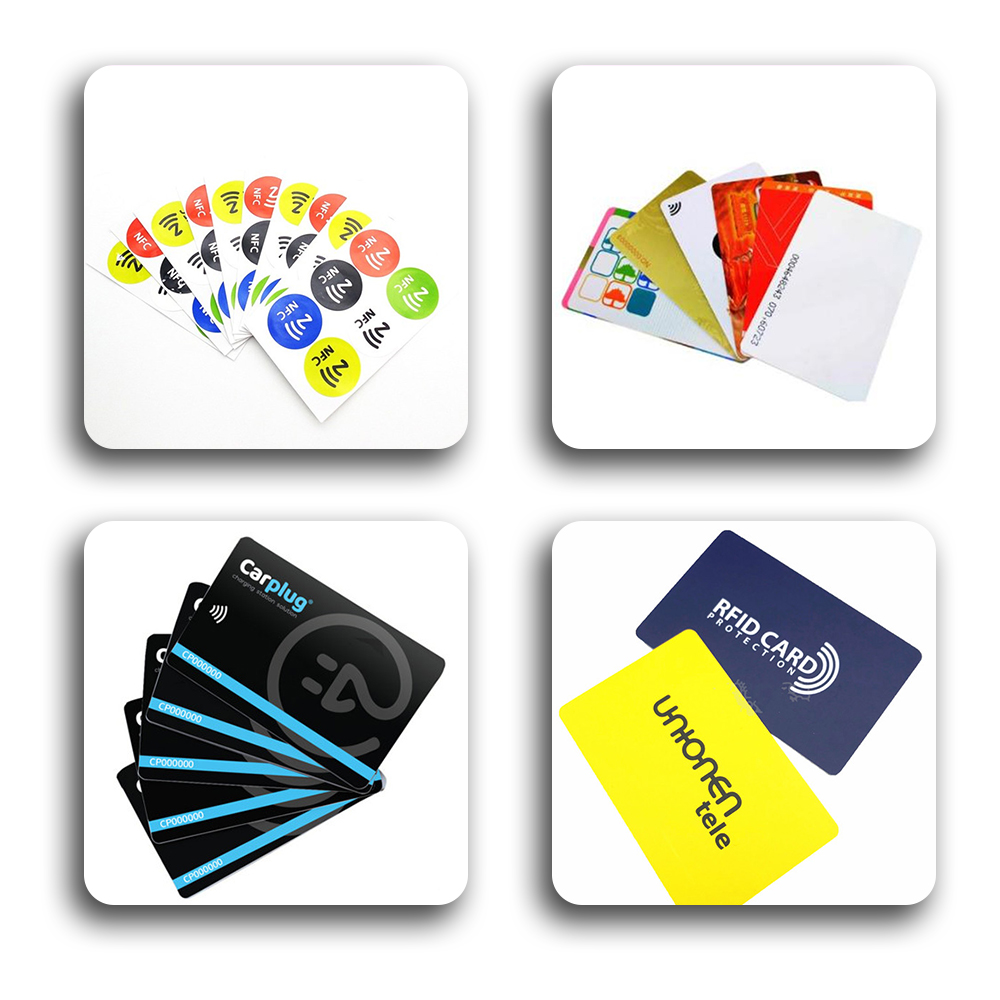
In the manufacturing process of RFID smart cards, bank cards, membership cards, game cards, star cards, playing cards, and various business cards, punching and forming is a high-risk and high-precision process. A typical RFID card has an extremely thin RF antenna embedded inside, with a coil diameter often only about 0.1mm, and is closely attached to the edge of the card for wiring. If the punching positioning deviates, the antenna will be directly cut off and the entire card will be instantly scrapped. For RFID special cards using winding technology, this antenna damage rate has long plagued the entire industry. The modern smart card punching machine fundamentally solves the positioning problem of “not damaging the antenna” through the combination of visual alignment system and step-by-step precise feeding technology. Starting from technical principles, this article analyzes how smart card punching machines can achieve efficient and accurate card die-cutting production while protecting the integrity of the antenna, and are suitable for processing diversified products such as cards, smart cards, business cards, game cards, playing cards, anime cards, bank cards, star cards, etc.
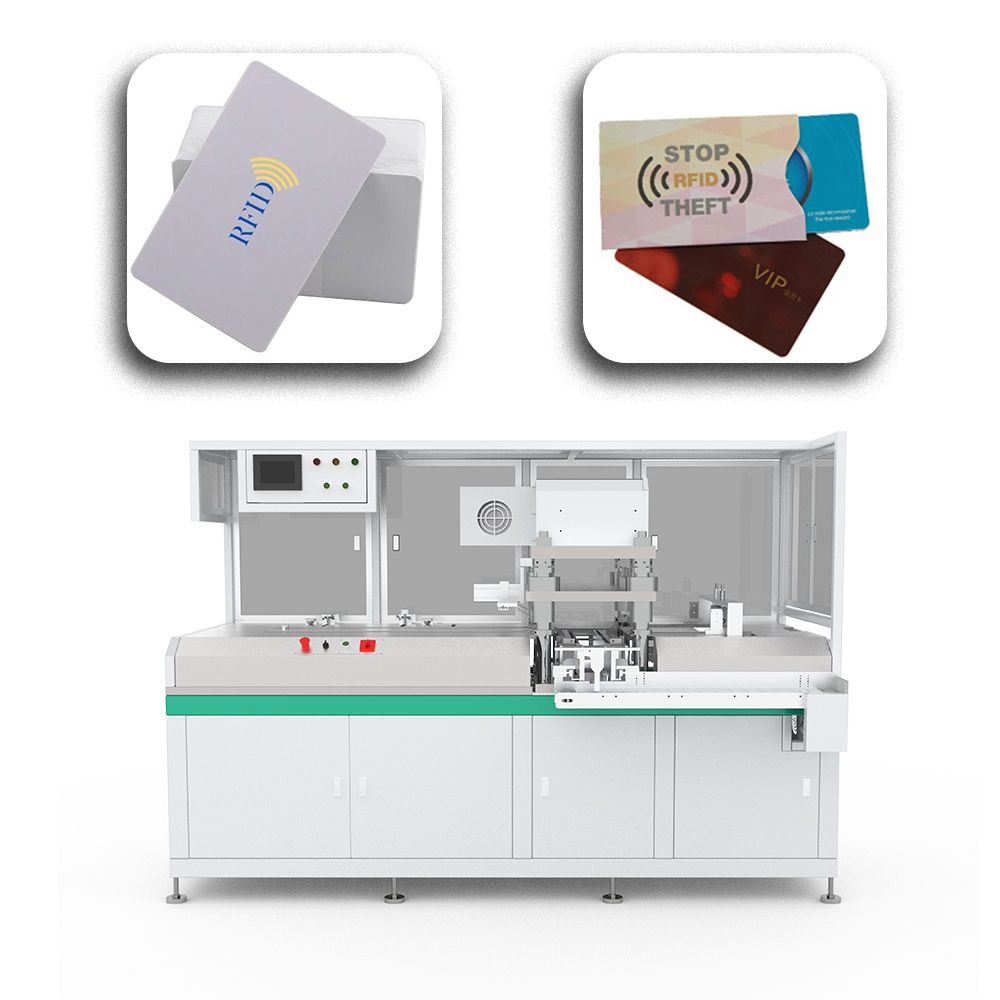
Visual registration system: the “eyes” of non-contact smart card punching machine
Traditional die-cutting equipment mostly adopts mechanical positioning methods, relying on the guide holes or physical blocks on the edge of the card to determine the punching position. This method is acceptable in the production of ordinary paper business cards or playing cards, but it exposes obvious defects in RFID card processing. Due to the micro scale stretching and twisting of PVC, PET or paper materials during transportation and tension due to temperature, humidity changes and tension fluctuations, mechanical positioning cannot compensate for these dynamic deviations in real time. More seriously, the contact positioning component may directly scratch the antenna area, causing invisible damage. This explains why modern smart card cutting machines must be equipped with a non-contact visual registration system – it is equivalent to the “eyes” of the device, which completes accurate positioning judgment before cutting.
The hardware components of the visual registration system include high-resolution CCD industrial cameras, coaxial or ring light sources, and embedded image processing units. During work, the camera continuously captures the pre printed registration cursor or dedicated positioning mark in the antenna area on the card layout. The system compares real-time images with the benchmark coordinates of mold design at high speed, and calculates the offset of the material at the current workstation in milliseconds, including X-axis horizontal displacement, Y-axis longitudinal displacement, and angular deflection. Subsequently, the control algorithm sends compensation instructions to the servo drive system to complete dynamic position correction during the last few millimeters of the punching head’s descent. This non-contact closed-loop mechanism of “first see, then adjust, and then punch” stabilizes the die-cutting positioning accuracy of the smart card punching machine at ± 0.03mm. For RFID bank cards and access cards with an antenna distance of only 0.5mm from the edge, this accuracy means that the antenna has sufficient cutting safety margin. The actual usage data in the Indian market shows that the antenna damage rate of smart card cutting machines equipped with visual alignment systems has decreased from 5% -8% of traditional equipment to below 0.3%.
Integrated automatic positioning and punching: a closed-loop solution to shorten the post press processing cycle
Visual positioning solves the problem of ‘where is the first one size fits all’, but in continuous production, ‘whether each knife is cut in the same position’ is equally crucial. During the high-speed punching process of traditional equipment, the small vibrations of materials, step errors of servo motors, and vibrations generated by mold impact will gradually accumulate, leading to drift in the subsequent punching position. This cumulative error becomes visible to the naked eye after processing hundreds of cards continuously, forcing operators to frequently shut down for calibration and severely restricting the switching efficiency of small batch orders. The step-by-step precise feeding technology is a closed-loop control scheme designed to solve this pain point, and it is also one of the core technologies of modern intelligent card punching machines.
The step-by-step feeding system uses high-precision ball screws and high inertia servo motors as actuators, and its working logic is a cyclic process of “feeding stopping detection punching re feeding”. After each punching is completed, the rotary encoder reads the actual movement distance in real time and feeds it back to the control system. If a deviation is detected between the current position and the set value, the system will automatically add a compensation amount in the next feeding instruction cycle to eliminate accumulated errors. This closed-loop control keeps the positioning stability within ± 0.1mm for each step, and there is still no significant drift after 5000 consecutive punching cuts. For products such as bank cards, celebrity cards, and gaming cards that require extremely high precision in finished product positioning and card edge quality, this means that the edges of each card are neat, straight, without burrs or steps.
This closed-loop solution also brings significant advantages in production flexibility. Traditional die-cutting equipment often needs to make nail holes or connecting points on the material to assist in fixing when processing small batch orders or sampling needs. The adjustment time usually exceeds 40 minutes, making it difficult to adapt to the “short, flat, and fast” order structure. The intelligent card punching machine, which adopts a step-by-step precise feeding and visual correction, only takes 15 minutes to adjust the overall machine time, and can directly die cut without nailing or connecting points. The mold changing time for wooden lightweight molds is further compressed to 2-3 minutes, allowing the equipment to quickly switch from playing card production to business card processing or small packaging box production. In the finished product collection process, the smart card punching machine provides two modes – sequential collection and classified collection. Users can flexibly configure according to their backend packaging needs, and even connect to backend packaging equipment to form a complete solution. For the large number of multi variety and small batch printing orders in the Indian market, this integrated design from feeding, punching and cutting to collection shortens the post press processing cycle by more than 40%.
The Application Evolution of Smart Card Punching Machines in All in One Card Manufacturing
The card manufacturing industry is undergoing a profound transformation from “single machine stacking” production to “integrated production line” production. In the past, an RFID card needed to go through multiple independent devices such as winding, chip mounting, laminating, printing, punching, and testing in sequence. The intermediate materials needed to be repeatedly transported and stacked, which not only occupied a large amount of factory space but also lost the positioning reference due to multiple clamping. The modern multi in one manufacturing mode integrates modules such as unwinding, printing, gluing, chip implantation, antenna winding, lamination, and punching and forming on the same production line, and materials can be produced as finished products in one operation. The smart card punching machine plays a core role in the die-cutting and forming process of this integrated chain – it not only needs to meet high-speed continuous operation, but also needs to be compatible with multiple materials and support fast order changing.
The intelligent card punching machine applied to the multi in one production line has the following technical features: firstly, it has wide material compatibility. In addition to the commonly used PVC, PET, and paper for cards, it also includes film and soft magnetic sheets, the latter of which is commonly used for the processing of magnetic cards and RFID anti metal tags; Secondly, the punching power is abundant, with a 7.5KW servo system providing sufficient cutting force to ensure that the card edges remain smooth and free of burrs in continuous production mode; Thirdly, the flexibility of order switching is high. As multi in one production lines usually handle orders from multiple customers simultaneously, the equipment must be able to quickly change molds and parameters. Actual testing has shown that from the end of the previous order to the production of the first qualified product in the next order, the entire machine adjustment time is controlled within 15 minutes, and the replacement of wooden lightweight molds only takes 2-3 minutes. This fast switching capability enables the smart card cutting machine to flexibly schedule products of completely different specifications, such as bank cards, game cards, star cards, playing cards, anime cards, etc., without any obstacles.
In addition to serving standardized bulk orders, smart card punching machines are also widely used in sampling and small batch verification scenarios. During the new product development phase, customers often need to quickly see the card edge quality and antenna safety of the finished product card. The smart card punching machine can use lightweight wooden molds for trial cutting without producing expensive metal molds, with minimal material loss during a single sampling and extremely convenient mold replacement operation. This dual attribute of being able to both sample and mass produce has made the equipment widely recognized in the printing industry. More than 70% of the equipment sold from our headquarters in Shenzhen, China to markets in India, Southeast Asia, the Middle East, and Europe and America, uses smart card cutting machines to complete sampling services and bulk order deliveries simultaneously. The three hard indicators of high precision in finished product position, good edge quality, and no burrs, combined with the two core technologies of visual correction and step-by-step feeding, together form the reliable technical foundation of modern intelligent card punching machines.
conclusion
The above technical solution provides quantifiable data support in actual production. The intelligent card punching machine adopts a visual registration system, with a stable die-cutting positioning accuracy of ± 0.03mm and an antenna safety pass rate of over 99.7%. Step by step precise feeding ensures that the positioning deviation of each step is controlled within ± 0.1mm, and there is no cumulative error in continuous punching and cutting for 5000 times. The fast switching ability of 15 minutes for overall machine adjustment and 2-3 minutes for mold change has shortened the post press processing cycle of small batch orders by more than 40% compared to traditional equipment. The two modes of finished product collection (sequential collection and classified collection) can be flexibly integrated with the backend packaging line to achieve a comprehensive solution from punching to packaging. These data indicate that the intelligent card punching machine equipped with visual correction positioning and step-by-step feeding technology not only fundamentally solves the technical problem of antenna damage in RFID special card processing, but also meets the urgent demand of the printing industry for the “short, flat and fast” production mode. Whether it’s bank cards, RFID smart cards, business cards, game cards, playing cards, anime cards, or celebrity cards, this technology solution has been validated in large-scale production and has become a trusted technology path in the global card manufacturing field.